Chicken Egg Incubators: Types, Sizes and How to Choose
The short answer
For hatching chicken eggs at home, buy a forced-air incubator with an automatic turner and a clear lid.
Choose the size by the hatch you plan: about 7 eggs for a family project, 20 to 30 for a small flock, and a cabinet only if you hatch every few weeks.
The Nurture Right 360 is the best all-round starter, Brinsea makes the steadiest small incubators, and the MATICOOPX 30 gives the most capacity for the money.
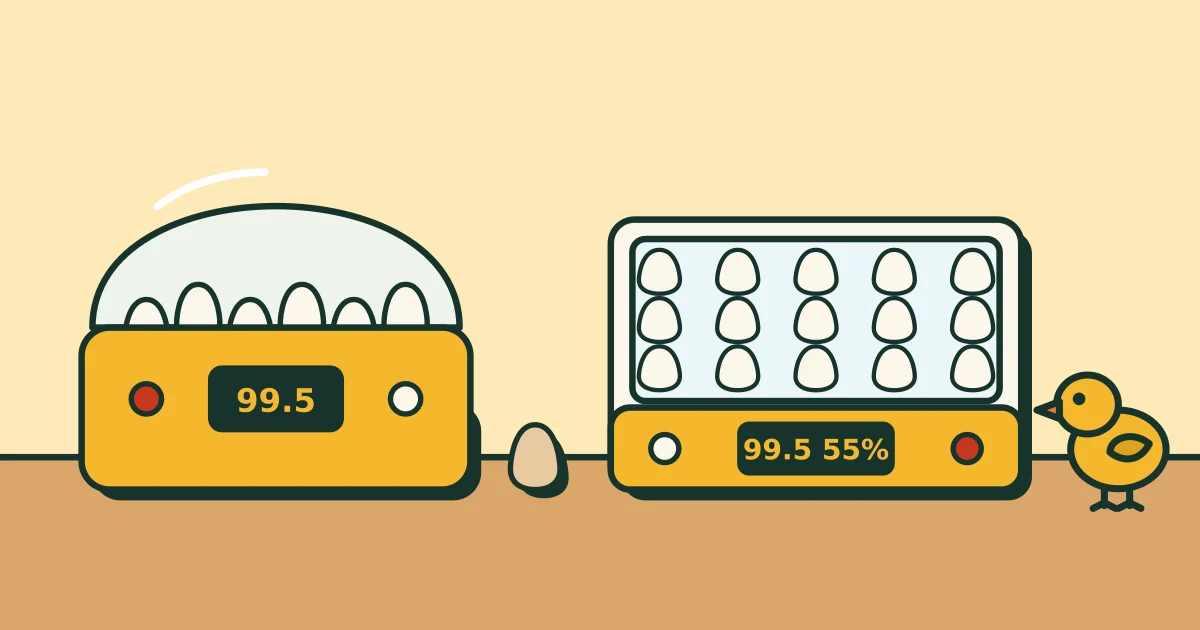
A chicken egg incubator does three things a broody hen does: it keeps eggs at 99.5°F, holds the right humidity, and turns them several times a day.
Every egg incubator on the market is a different answer to how much of that work it does for you.
This guide explains the choices, shows which incubators for hatching eggs suit which keeper, and points you to our detailed guides for each type.
Types of chicken egg incubator
Forced air and still air
A forced-air incubator has a fan that circulates warm air, so every egg sits at the same temperature. A still-air incubator has no fan, and the air is warmer at the top than at the bottom.
Still-air models are cheaper, but they are harder to run well. For a first incubator, choose forced air.
Manual, semi-automatic and automatic turning
Eggs must be turned at least three times a day for the first 18 days. With a manual incubator you do it by hand, opening the lid each time.
A semi-automatic model lets you turn all the eggs with one lever from outside. An automatic turner does it on a timer.
Automatic turning is the feature most worth paying for, because the lid stays shut.
Tabletop and cabinet
Tabletop incubators hold from a handful of eggs to around 50 and suit nearly every backyard keeper.
Cabinet incubators hold 60 to several hundred eggs on trays, set and hatch in stages, and make sense only if you hatch continuously.
What size incubator for chicken eggs do you need?
| Product | Chicken eggs | Best for | Turning | Link |
|---|---|---|---|---|
| Brinsea Mini II Advance Incubator (7 Eggs) | 7 | Family or classroom hatch | Automatic | View |
| Harris Farms Nurture Right 360 Incubator | 22 | A first backyard flock | Automatic | View |
| Brinsea Maxi 24 Advance Incubator | 24 | Regular spring hatches | Automatic | View |
| MATICOOPX 30 Egg Incubator | 30 | Most eggs for the money | Automatic | View |
| Hatching Time CT60SH Setter and Hatcher | 60 | Hatching every few weeks | Automatic | View |
Plan on half to three quarters of fertile eggs hatching, and half the chicks being cockerels. To end up with six laying hens, set about 18 to 24 eggs.
The features that matter
- A fan. Even temperature across all the eggs.
- Automatic turner. No lid lifting for 18 days.
- A clear lid or dome. You can check the eggs and watch the hatch without opening it.
- External water fill. Top up humidity without losing heat.
- Humidity display. Useful, but check it against a separate hygrometer.
- Day countdown and auto-stop. The incubator stops turning before hatch day so you do not have to remember.
- Easy cleaning. Hatching is messy. Smooth plastic cleans better than foam.
Our picks by need
Best all-round starter

Harris Farms Nurture Right 360 Incubator
- 22 chicken eggs with automatic turning and auto-stop
- Fan, clear 360 degree dome and external water port
- Display shows temperature, humidity and days to hatch
What owners say
Praised for: very easy to use; high hatch rates when conditions are right; great view of the hatch.
Common complaints: built-in humidity and temperature readings are often off; turner motors that fail on some units; humidity is hard to hold steady in dry rooms.
Check price on Amazon$100.59
Price as of Nov 17, 2026, 3:20 PM UTC. Details
Product prices and availability are accurate as of the date/time indicated and are subject to change. Any price and availability information displayed on Amazon at the time of purchase will apply to the purchase of this product.Read more in our Nurture Right 360 review.
Steadiest small incubator

Brinsea Mini II Advance Incubator (7 Eggs)
- Seven eggs, automatic turning, hatch-day countdown
- Very stable fan-assisted temperature
- Made by a specialist incubator company
What owners say
Praised for: dependable hatches; very simple to set up and run.
Common complaints: expensive for seven eggs; humidity can run low without extra water; a few reports of temperature swings.
Check price on Amazon$249.99
Price as of Nov 17, 2026, 3:20 PM UTC. Details
Product prices and availability are accurate as of the date/time indicated and are subject to change. Any price and availability information displayed on Amazon at the time of purchase will apply to the purchase of this product.Most capacity for the money

MATICOOPX 30 Egg Incubator
- 30 eggs with automatic turner
- Humidity display, built-in candler, external water fill
What owners say
Praised for: strong hatch rates; very easy to use and clean; good value.
Common complaints: egg turner motors and trays that break; some units drift on temperature or humidity.
Check price on Amazon$119.99
Price as of Nov 17, 2026, 3:20 PM UTC. Details
Product prices and availability are accurate as of the date/time indicated and are subject to change. Any price and availability information displayed on Amazon at the time of purchase will apply to the purchase of this product.See our MATICOOPX 30 review for setup tips.
Buying details: what to budget for
- The incubator. Tabletop automatic models cover almost every backyard need.
- Thermometer and hygrometer. A separate one to check the built-in readings.
- Candler. To see which eggs are developing.
- Fertile eggs. Local eggs hatch far better than shipped eggs.
- Brooder. A box, bedding, chick feeder and drinker, and a heat plate, ready before day 21.
Electricity is a minor cost. A tabletop incubator uses a few cents a day.
Incubators for other species
Chicken incubators will hatch other birds if the turner fits the eggs and you adjust the days and humidity.
- Quail: small eggs need quail trays or a small-egg insert. See best quail egg incubators.
- Ducks: larger eggs, 28 days and more humidity at the end. See best incubators for duck eggs.
- Every species in one place: incubator temperature and humidity chart.
How to hatch chicken eggs: the short version
- Set up early. Run the incubator for 24 hours and check it with a separate thermometer.
- Set the eggs. Use clean, fresh, fertile eggs. Let shipped eggs rest for a day first.
- Days 1 to 18. Hold 99.5°F and 45 to 55 percent humidity. The turner does the rest.
- Candle on day 7 and day 14. Remove eggs that are clear or have stopped developing.
- Day 18, lockdown. Stop turning, raise humidity to 65 to 70 percent, and keep the lid shut.
- Day 21, hatch. Leave chicks in the incubator until they are dry and fluffy, then move them to a warm brooder.

IncuTherm Plus Thermometer and Hygrometer
- Digital thermometer and hygrometer with a remote probe
What owners say
Praised for: easy to read; helps owners get high hatch rates.
Common complaints: accuracy varies between units; goes through batteries.
See it on Amazon$28.99
Price as of Nov 17, 2026, 3:20 PM UTC. Details
Product prices and availability are accurate as of the date/time indicated and are subject to change. Any price and availability information displayed on Amazon at the time of purchase will apply to the purchase of this product.After the hatch
Chicks need about 95°F for their first week, dropping by 5 degrees a week. A brooder heat plate is the safest way to provide it.
See best brooder heat plates.
Compare incubators in detail
If you are ready to choose a model, start with best egg incubators for beginners.
Frequently asked questions
What is the best incubator for chicken eggs?
For most backyard keepers, a 20 to 30 egg forced-air incubator with automatic turning, such as the Nurture Right 360.
It is large enough for a useful hatch, small enough for a kitchen counter, and does the turning for you.
How much does a chicken egg incubator cost?
Small manual incubators start under 100 dollars. Good automatic tabletop models for 20 to 30 eggs sit between roughly 100 and 250 dollars.
Incubators with automatic humidity and cabinet incubators cost several hundred dollars and up.
How long does it take to hatch chicken eggs in an incubator?
Twenty-one days at 99.5°F in a forced-air incubator. Turning stops on day 18 and humidity is raised for the last three days.
Can you hatch store-bought eggs?
No. Supermarket eggs are not fertile and have been refrigerated.
You need fresh fertile eggs from a flock with a rooster, a breeder or a hatchery.
Is an incubator better than a broody hen?
A broody hen does everything for you and raises the chicks, but you cannot schedule her and she can only cover about a dozen eggs.
An incubator works on your timetable and at any scale, and then you need a brooder for the chicks.
Where can I buy fertile chicken eggs?
From local keepers with a rooster, breeders, and hatcheries that ship hatching eggs. Local eggs that have not been through the post give the best hatch rates.
How long can fertile eggs wait before going in the incubator?
Up to about seven days stored pointed end down at around 55 to 60°F. Hatch rates fall with each day beyond that.
Do incubators use a lot of electricity?
No. Most tabletop incubators draw under 50 watts, and less once warm.
A full 21 day hatch costs well under a few dollars.
Can I reuse an incubator straight away?
Yes, once it has been washed, disinfected and dried. Leftover shell and fluff carry bacteria into the next hatch.